
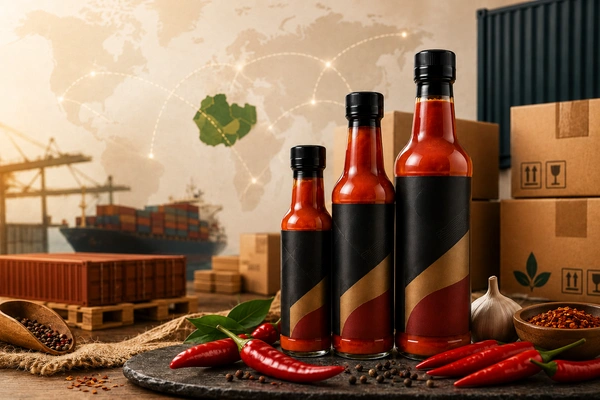
A hot sauce can taste excellent and still become a costly import problem. An incomplete label, an ingredient that needs review or insufficient remaining shelf life can delay a shipment. Weak closures and cartons can also reduce the value of otherwise compliant stock.
For importers, distributors, grocery buyers and restaurant groups, checking hot sauce import requirements before production is safer than correcting mistakes after shipment. This guide provides a practical checklist for the UAE, Saudi Arabia, Qatar, Kuwait, Oman and Bahrain.
Important: GCC countries share regional standards and customs principles, but registration, label approval and clearance are still handled by national or local authorities. Always confirm the final requirements with your licensed importer or compliance adviser in the destination country.
Why Hot Sauce Import Requirements Must Be Checked Before Ordering
Import compliance starts before the purchase order. Buyer and supplier should agree on the recipe, packaging, label, documents and shipping terms. Late decisions can lead to relabelling, port delays or rejection.
Regional guidance addresses food safety, accurate information and border control, but Dubai, Riyadh and Doha do not necessarily use the same registration process. Treat GCC rules as a foundation and verify country-specific steps for every SKU.
GCC Buyer’s Checklist at a Glance
|
Area |
What the buyer should verify |
Risk if overlooked |
|
Formula |
Ingredients, additives and allergens |
Reformulation or rejection |
|
Label |
Language and mandatory information |
Delayed approval |
|
Shelf life |
Dates and remaining life on arrival |
Unsaleable stock |
|
Documents |
Matching commercial and product records |
Customs delay |
|
Packaging |
Closures, cartons and pallets |
Transit damage |
|
Supplier |
Consistency and production capacity |
Supply disruption |
|
Terms |
MOQ, Incoterm and landed cost |
Excess cost or stock |
Use this table as a screening tool, then confirm the details for the destination and sales channel.
1. Lock the Formula and Product Specification
First define what is inside the bottle. The specification should identify ingredients, net content, storage conditions, shelf life and the approved colour, texture and heat level.
Hot sauce may contain chilli, vinegar, salt, sugar, spices, thickeners, preservatives or colours. Every ingredient must be correctly named, permitted and declared. Allergens, additives and animal-derived ingredients may change the documentation required.
Claims such as “organic”, “natural” or “no preservatives” require evidence. NIMARA prioritises fresh, organic ingredients, but buyers needing certified-organic status should confirm the certificate scope for the exact SKU.
Before placing a bulk order, request:
- product specification and approval sample
- ingredient and allergen statement
- shelf-life and storage information
- relevant analysis documents
A professional hot sauce supplier should be comfortable putting the approved specification in writing.
2. Prepare the Label for the Destination Market
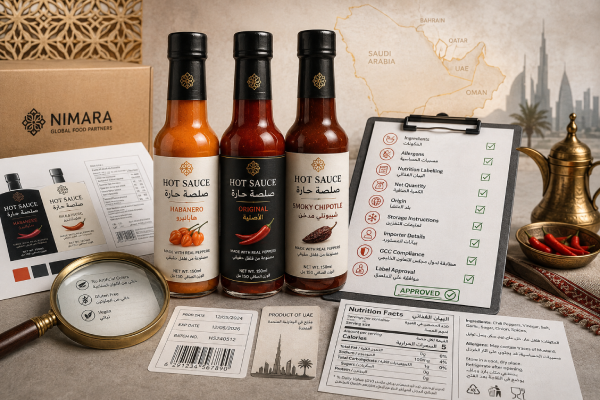
Labels identify the product for authorities and consumers. Buyers commonly need to review the product name, ingredients, allergens, net quantity, origin, manufacturer or importer details, nutrition information, storage instructions and date marking.
Arabic information is central to GCC food labelling, although label format and supplementary stickers should be confirmed locally. Translations must match the original artwork and must not obscure essential information.
Check the label before printing thousands of units:
- Is the product name clear in the required language?
- Are ingredients, allergens and additives accurate?
- Do weight, dates and storage conditions match the specification?
- Are origin and importer details consistent?
- Has the local importer approved the artwork?
For current regional principles, buyers can consult the official GCC Guide for Control on Imported Foods and then verify the destination’s current national process.
3. Build a Clean and Consistent Document Set
Good documentation means supplying the correct records for the product, origin, shipment and destination, with matching information throughout.
A typical commercial file may include:
- invoice, packing list and transport document
- certificate of origin
- product specification and ingredient statement
- health, analysis or conformity documents where required
- evidence supporting Halal, organic or other claims
Descriptions, quantities, weights and origin should match. A reliable hot sauce exporter reviews the invoice, label and carton markings before dispatch rather than finding errors at port.
4. Protect Shelf Life and Packaging on Long Routes
Buyers need enough remaining shelf life for clearance, warehousing, distribution and sale. Agree on the minimum life at dispatch and arrival, not only the total life from production.
Packaging must survive the route. Check seals, closures, dividers, cartons and pallet patterns. Request carton, pallet and container-loading data before comparing freight.
NIMARA offers 90 g, 200 g and 400 g formats. Compact units suit retail trials or table service; larger bottles fit regular household demand. Protective secondary packaging and stable loading help reduce movement, crushing and leakage on long routes.
5. Match the Order to the Sales Channel
Restaurants may prioritise controlled use and consistent flavour. Grocery stores need shelf-ready presentation at the right price point. Distributors need carton efficiency, dependable replenishment and useful size options.
Before choosing a wholesale hot sauce supplier, define:
- channel and expected volume
- bottle size and case quantity
- target landed cost
- destination port and Incoterm
- repeat-order frequency
This information allows the supplier to quote a commercially relevant order instead of a generic price per bottle.
6. Account for Differences Between GCC Countries
Approval in one GCC country does not guarantee entry into all six. The UAE uses relevant local registration systems; Saudi imports are overseen by the Saudi Food and Drug Authority; Qatar, Kuwait, Oman and Bahrain have their own authorities and workflows.
Treat each destination as a separate launch. Confirm the importer’s licence, registration responsibility, label approval, testing and certificates before production. The GCC Unified Guide for Customs Procedures is useful but does not replace local approval.
7. Choose a Supplier Who Can Support Compliance
The strongest hot sauce for importers reaches the market in saleable condition, with consistent quality and usable documents—not merely a low factory price.
Ask a potential supplier:
- Can you reproduce the approved sample?
- Which documents can you issue?
- How is packaging prepared for long routes?
- What is the MOQ per size or label?
- What is the repeat-order lead time?
Answers should be specific. “Export quality” is not a substitute for written specifications, packing details and dates.

Why NIMARA Is a Leading Hot Sauce Supplier for GCC Buyers
NIMARA combines product quality with export practicality. Fresh, organic ingredients support clean flavour, reliable colour and consistent performance. Its 90 g, 200 g and 400 g options serve grocery, restaurant, café and distribution channels.
Secure closures, protective cartons and stable loading help NIMARA products travel farther with less risk. Responsive B2B communication also helps buyers confirm specifications and packing before production.
For buyers comparing a hot sauce exporter or sourcing hot sauce for importers, NIMARA offers:
- fresh, carefully selected ingredients
- consistent flavour and multiple sizes
- export-conscious packaging
- support for specifications and order planning
- a wider food portfolio for distributors
Explore NIMARA’s export food range to see additional products for retail, foodservice and distribution.
Request a GCC-Focused Hot Sauce Quote
Meeting hot sauce import requirements becomes easier when product, label and logistics decisions are made before shipment. Send NIMARA your destination country, preferred size, estimated volume, sales channel and label requirements. The team can then discuss the most suitable product and packing arrangement for your market.
Contact NIMARA to request product details and a tailored quotation for your next bulk hot sauce order.